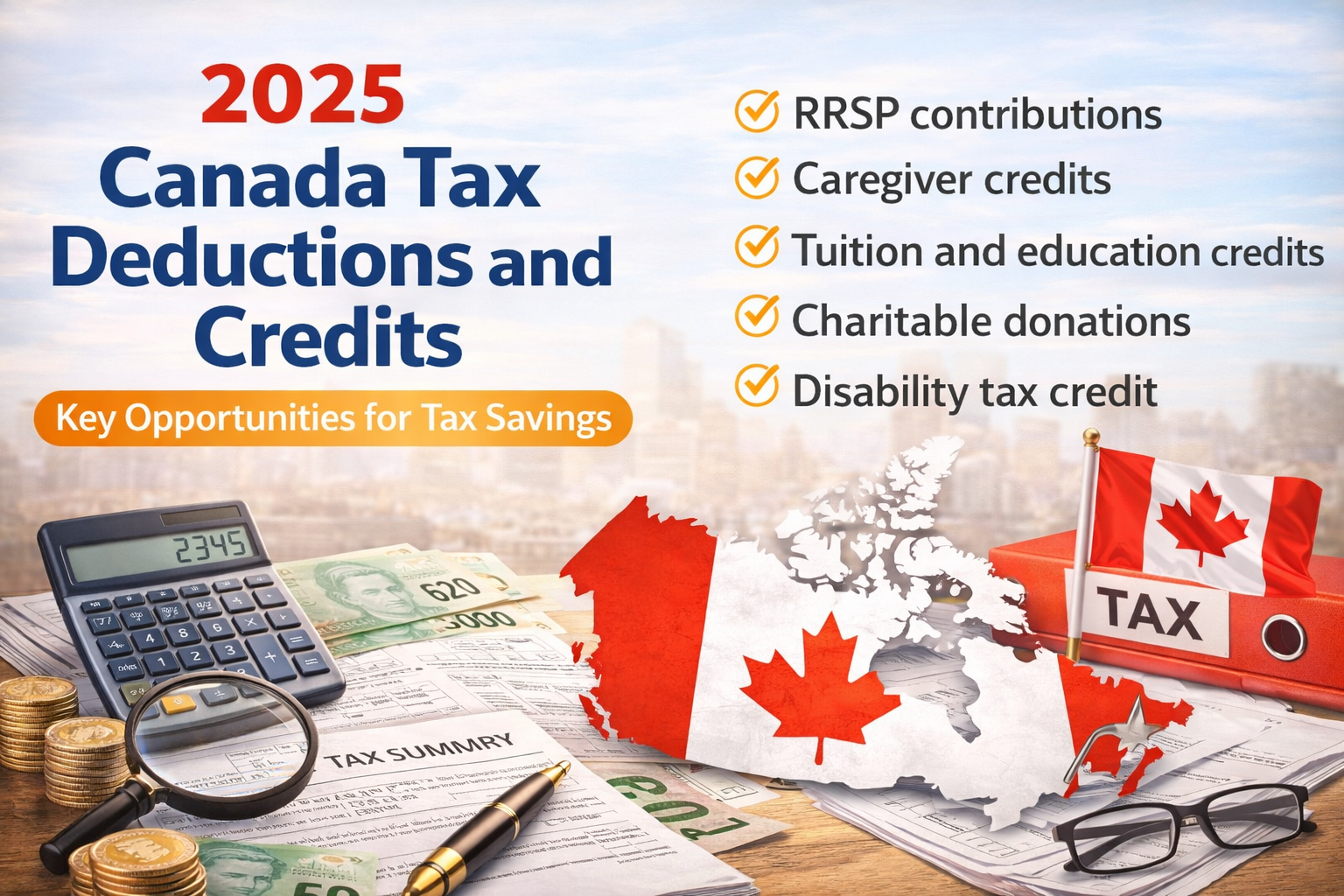
2025 Canada Tax Deductions and Credits
Tax season is approaching, and many Canadians are asking the same question:
“Am I maximizing my tax deductions and credits?”
Each year, the Canada Revenue Agency (CRA) offers hundreds of tax deductions, credits, and benefits that can significantly reduce your tax liability. However, many taxpayers miss valuable opportunities simply because they are unaware of what they can claim.
Whether you are a student, employee, investor, business owner, landlord, or retiree, understanding the most important tax deductions can help you optimize your 2025 Canadian income tax return.
This guide explains the key deductions, tax credits, and documents you should prepare before filing your Canadian taxes in 2025.
Canada Caregiver Credit and Related Tax Benefits
If you financially support or care for a dependent individual, you may qualify for the Canada Caregiver Credit (CCC).
The Canadian government considers you eligible if you provide care for a dependent who has a physical or mental impairment, including:
- Children
- Elderly parents or grandparents
- Spouses or common-law partners
- Other dependent relatives
Eligible caregiving expenses may include:
- Childcare expenses
- Daycare costs
- Babysitting expenses
- Adoption-related expenses
- Care costs for dependents with disabilities
These credits are designed to help families reduce the financial burden of caregiving responsibilities.
Proper documentation is essential to support these claims if requested by the CRA.
Tuition Tax Credits for Students
Students should always download their T2202 Tuition and Enrolment Certificate before filing taxes.
This slip allows you to claim the Tuition Tax Credit, which reduces federal and provincial income tax payable.
Important points:
- Students receive the credit even if they have little or no income
- Unused tuition credits can be carried forward to future years
- A portion may be transferred to a parent, spouse, or grandparent
Most universities and colleges provide the T2202 slip through the student portal.
Claiming this credit properly can result in significant future tax savings.
Charitable Donation Tax Credits
If you donated to charities during the year, those contributions may qualify for Charitable Donation Tax Credits.
To claim donations:
- The organization must be a registered Canadian charity
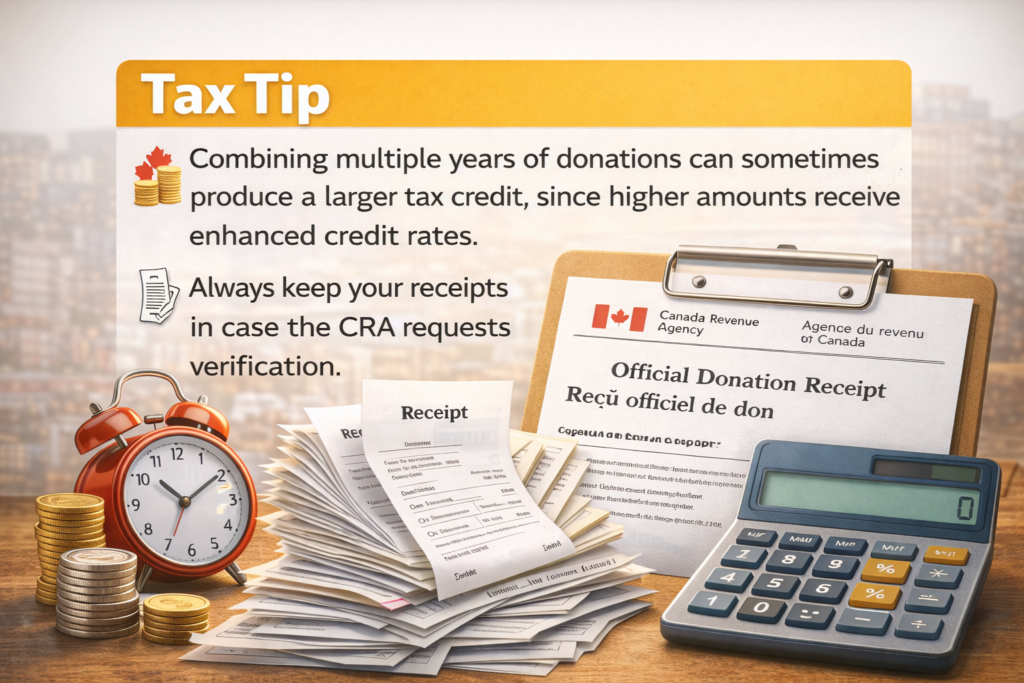
- You must receive an official donation receipt
- Donations to non-registered organizations cannot be claimed
Disability Tax Credit (DTC)
The Disability Tax Credit (DTC) is a non-refundable tax credit designed to help individuals with severe and prolonged impairments.
Eligibility requires:
- A significant restriction in daily living activities
- Certification by a qualified medical practitioner
- Approval from the CRA through Form T2201
If approved, the credit may:
- Reduce income tax payable
- Be transferred to a supporting family member
- Allow eligibility for additional programs such as the Registered Disability Savings Plan (RDSP)
RRSP Contributions and Tax Deductions
RRSP contributions remain one of the most valuable 2025 Canada tax deductions and credits available to Canadian taxpayers.
For the 2025 tax filing season, RRSP contributions are based on 18% of earned income from the previous year, up to the annual CRA limit.
For the 2024 tax year (filed in 2025):
- The maximum RRSP contribution limit is $31,560
- Unused contribution room carries forward indefinitely
RRSP contributions:
- Reduce taxable income
- Can increase eligibility for certain income-tested benefits
- Help grow retirement savings tax-deferred
Always verify your RRSP contribution room on your CRA My Account before making contributions.
Pension Income: OAS and CPP Slips
If you receive retirement income, ensure you include the following tax slips:
- T4A(OAS) – Old Age Security payments
- T4A(P) – Canada Pension Plan benefits
These slips are typically available in your CRA My Account or through Service Canada.
Accurate reporting ensures your tax return is complete and avoids reassessments.
Employment Income and T4 Slips
Most Canadian employees receive a T4 Statement of Remuneration Paid from their employer.
Employers must issue T4 slips by the end of February each year.
Employees may also claim employment expenses if:
- They were required to pay work-related costs
- Their employer did not reimburse them
- They received a signed Form T2200
Eligible employment expenses may include:
- Home office expenses
- Vehicle expenses
- Work-related travel
- Supplies required for employment
Maintaining receipts and documentation is critical if claiming these deductions.
Home Office Expense Deduction (Remote Workers)
Employees who work from home may claim home office expenses under the CRA’s detailed method.
Eligible expenses may include:
- Rent
- Utilities
- Internet costs
- Maintenance expenses
The deduction is generally calculated based on the percentage of your home used for employment purposes.
Important Note
The temporary flat-rate method used during the COVID-19 pandemic is no longer available, so employees must now use the detailed calculation method and obtain Form T2200 from their employer.
Medical Expense Tax Credit
You may claim eligible medical expenses paid for:
- Yourself
- Your spouse or common-law partner
- Dependent children under 18
Common eligible expenses include:
- Prescription medications
- Dental treatments
- Medical devices
- Vision care
- Travel expenses for medical treatment
Medical expenses must exceed the CRA threshold (indexed annually) before the credit applies.
Keeping organized receipts throughout the year makes claiming this credit much easier.
Reporting Investment Income and Capital Gains
Canadian taxpayers must report capital gains and investment income accurately.
Common investments include:
- Stocks
- ETFs
- Mutual funds
- Cryptocurrency
- Real estate investments
To calculate capital gains, keep records of:
- Purchase price
- Sale price
- Brokerage commissions
- Number of shares sold
Canada uses the Adjusted Cost Base (ACB) method to determine gains or losses.
Example: Weighted Average Cost Method
Suppose you purchased shares as follows:
- 10 shares at $10
- 10 shares at $12
- 10 shares at $14
Total cost:
$100 + $120 + $140 = $360
Average cost per share:
$360 ÷ 30 = $12 per share
This average becomes the Adjusted Cost Base (ACB) when calculating capital gains.
Only 50% of capital gains are taxable in Canada under current federal tax rules.
Rental Property Income and Real Estate Sales
If you own rental property, you must report rental income and expenses on your tax return.
Important documents include:
- Rental income records
- Mortgage interest statements
- Property tax receipts
- Repair and maintenance expenses
If you sold real estate, you must report:
- Purchase price
- Selling price
- Legal fees
- Closing costs
Proper documentation is essential for calculating capital gains or losses.
Foreign Asset Reporting (T1135 Form)
If the total cost amount of foreign assets exceeded $100,000 CAD at any time during the year, you must file Form T1135 – Foreign Income Verification Statement.
Examples of foreign assets include:
- Foreign stocks
- Foreign bank accounts
- International investment funds
- Foreign rental property
Failure to file Form T1135 can result in penalties starting at $25 per day, up to $2,500.
Your accountant may request:
- Foreign tax slips
- Foreign tax returns
- Notices of assessment
These documents help claim foreign tax credits and avoid double taxation.
Cryptocurrency Tax Reporting in Canada
Cryptocurrency transactions are taxable in Canada.
Depending on activity, crypto gains may be classified as:
- Capital gains (for investors)
or - Business income (for active traders)
Taxpayers should track:
- Buy and sell transactions
- Trading fees
- Transfers between wallets
- Realized gains and losses
Using crypto tax software can help generate accurate tax reports.
Tax Tips for Sole Proprietors and Self-Employed Individuals
Self-employed individuals must report business income on Form T2125 – Statement of Business or Professional Activities.
Start by preparing an income statement, including:
- Revenue
- Cost of goods sold
- Business expenses
Common deductible expenses include:
- Equipment purchases
- Machinery
- Business tools
- Advertising
- Office supplies
- Software subscriptions
Large purchases may be depreciated using Capital Cost Allowance (CCA), which spreads deductions over several years.
Other common deductions include:
- Home office expenses
- Vehicle expenses
- Business insurance
- Utilities related to business operations
Accurate bookkeeping is essential to maximize deductions and remain compliant with CRA rules.
Final Thoughts: Maximize Your 2025 Tax Savings
With hundreds of 2025 Canada tax deductions and credits available, properly preparing your tax return can significantly affect your financial outcome.
By organizing documentation and understanding eligible deductions, Canadians can ensure their 2025 tax return is accurate and optimized for savings.
Working with a professional accountant or tax advisor can help identify opportunities, reduce tax liability, and ensure compliance with CRA regulations.
Learn more: Personal Taxation in Canada: An Essential Guide to Understanding the System
Frequently Asked Questions (FAQs)
What is the RRSP contribution limit for 2024 income?
For the 2024 tax year (filed in 2025), the RRSP contribution limit is:
18% of earned income from the previous year, up to $31,560.
What is the penalty for not filing the T1135 form?
Penalties can reach $2,500 or more, depending on how long the form remains unfiled.
Can I claim home office expenses if I work remotely?
Yes. However, employees must now use the CRA detailed method and obtain Form T2200 from their employer.
Are cryptocurrency profits taxable in Canada?
Yes. Crypto gains may be taxed as capital gains or business income, depending on trading activity.
What medical expenses are deductible in Canada?
Eligible expenses include:
- Prescription medications
- Dental care
- Vision care
- Medical devices
- Certain travel expenses for medical treatment